Knitting_2x2
The inspiration for the bracelet design was drawn from a hand-knitted vest, in which two knit stiches and two purl stitches rhythmically alternate. Since the pattern (ribbing) is commonly used for sweater cuffs, I translated the design into a bracelet.

The research began with experiments in the visualisation of knitted structures using 3D - modelling. The first step was the development of a technique for repeating loops according to the topology of a simulated garment. I began the process by modelling a single loop and arranging it so that the repeat could continue seamlessly. Using curves, I shaped the basic silhouette of the loop and gradually added depth and thickness until a satisfactory repeating pattern was achieved.


During testing of the loop repetition, numerous issues arose, as control over the distribution of loops across the entire garment was not yet feasible at this stage. I therefore decided to apply the technique – jewellery.
In the initial execution, I planned to use 3D printing, specifically FDM (fused deposition modelling) technology. The first prototypes had loops merged one to another, as this better suited the requirements of FDM printing. However, such models proved to be very rigid, exhibited unwanted flaws, and resulted in aesthetically unsatisfactory finishes.

Due to these limitations, I switched to SLM (selective laser melting) technology, which allows for more precise production, finer finishes and most importantly, 3D printing in CoCr (cobalt chrome) alloy. Meanwhile it also imposes fewer structural constraints and support elements during printing. I adapted the model by optimising the thickness and spacing between loops so the system would function like a true knitted structure – a single interlacing thread.
After modelling a single loop I used colored markings on a base form of the bracelet to determine the stitches used. As the bracelet is open on the underside, I paid particular attention to ensuring a smooth continuation of the loop pattern in this area as well.


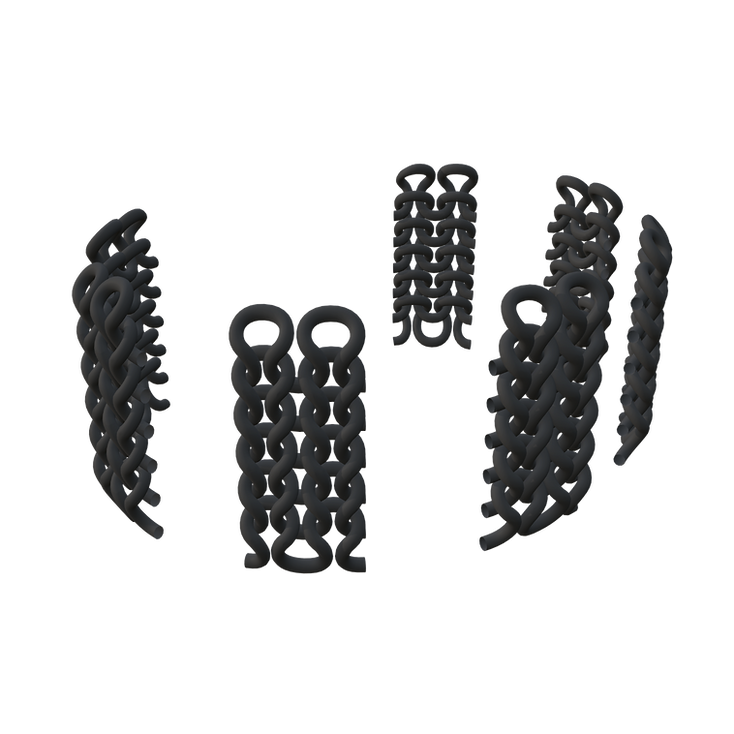
The final jewellery piece was made with SLM (selective laser melting) technology and 3D – printed in CoCr (cobalt chrome). Polished with plasma because traditional jewellery polishing techniques did not work due to its complex shape and tightly knitted structures.
